General News
7 November, 2025
Heritage pool caps $14M on the road to reopening
Central Goldfields Shire Council pulls back the curtain on why the pool's cost continues to balloon.
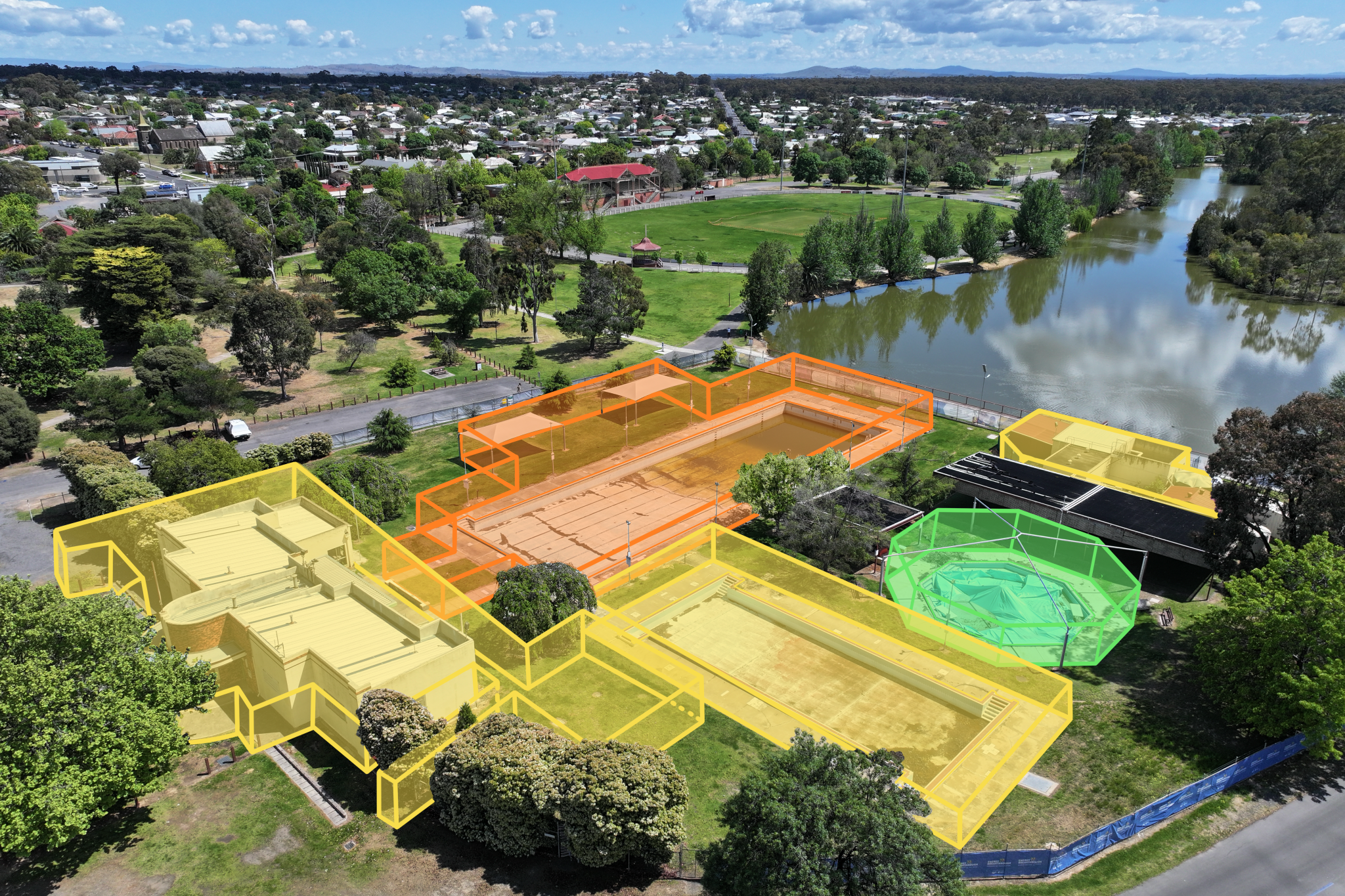
The cost of fully reopening the Maryborough Outdoor Pool Complex has reached $14 million, over double the original estimate, and is likely to increase further. Here’s what we know about the reasons why.
Central Goldfields Shire Council recently revealed that their over $10 million project estimate, which originally was $6 million in 2022, has increased again.
The news was quietly shared within council’s annual report at last month’s council meeting.
There were numerous reasons for the increase according to council, including an almost $2.4 million increase to construction costs, expanded scope, contingency planning, and the natural progression of the project as their understanding improved.
It means council’s funding shortfall has quintupled despite having secured $9 million of state and federal government funding earlier this year.
However, according to Central Goldfields Shire Council CEO Peter Harriott, this is an expected part of delivering a complex long-term project.
He said as council works on the facility, they get better information which improves their estimates.
“That’s just the nature of project delivery,” he said.
Demolishing and rebuilding the complex was estimated to cost $6 million when it closed in 2022, then $8 million in 2023, and over $10 million earlier this year.
It’s a price hike Mr Harriott said wasn’t concerning.
He said the $6 million estimate was only for a concept, without further information, with the accuracy of someone whose “thrown a figure out”.
“I’m not that concerned that we’ve gone from that to where we are now because that’s just the maturing of the project,” Mr Harriott said.
But why not just ‘future proof’ the estimate so it doesn’t change?
“Future proofing becomes more accurate the further you go,” Mr Harriott said.
Not only is the Maryborough Outdoor Pool Complex in an early stage of development but is a unique case within the construction industry.
“We’ve got to understand where this pool fits in the industry and what the current rate of cost escalation is,” Mr Harriott said.
“That’s difficult to determine because ... the specific nature of this pool is just individual to here.”
Among those considerations is the complex’s heritage listing.
It means any works must look the same as the original and be reconstructed using like for like materials. Exceptions, such as to meet modern standards, must be negotiated with Heritage Victoria.
While it’s possible to remove the heritage listing, council said applicants are rarely approved.
This is made more difficult because of the octagonal pool’s success which shows the pools can be rebuilt while keeping their heritage value.
It’s this, among the project’s other challenges, which means cost estimates are refined throughout the project’s stages.
The formerly two stage project was introduced earlier this year due to the complex’s escalating costs and council’s tight financial position.
Council were also advised by State Government that if they extended the project scope to include equal access upgrades, and broke it up into stages, it’d improve their chance of receiving funding.
They later received a Victorian grant for $3 million with a $1.5 million council co-contribution.
The original first stage, which was expected to cost $4.5 million, included the design of the entire complex, repair of the 25-metre learn-to-swim pool, including the installation of new filtration, and building contemporary change rooms.
Once it was complete, council aimed to negotiate the partial reopening of the pool with their operational contractor — this is still planned.
In the meantime, the Olympic-sized pool in stage two, with a high level estimate of $5.5 million, could be worked on while the community had partial access to the facility.
However, Mr Harriott revealed the project is now split across three stages which are largely similar to the previous structure.
Stage one is the octagonal wading pool and is complete.
Leftover funding from those works was also used on pavilion conservation. This included a new roof, asbestos removal, and render repairs.
Stage two and three were previously communicated as stage one and two and have a similar scope.
However, the cost of the stages now rests with the market rather than council’s estimates.
“These are our best estimates, our best knowledge of the project as it stands, but you never know until you put the tenders out and you test the market,” Mr Harriott said.
Tenders are expected to go out in the 2026/27 financial year following the completion of the complex’s detailed design by June 30, 2026.
“The market will tell us if we’ve got the estimate right,” he said.
Construction on stage two is estimated to be complete by the end of the 2026/27 financial year.
Mr Harriott said he expects council will have a stronger understanding of the Olympic-sized pool’s cost once they’ve completed the other two stages.
A council spokesperson also said that a timeline for stage three will be confirmed once the Federal Government’s election commitment of $4.5 million is secured.
“A timeline for stage three will be confirmed once council has secured the federal election commitment funding and a signed funding agreement, ensuring a clear and transparent approach to delivery,” they said.
Member for Ripon Martha Haylett said she hasn’t seen the explanation for why the project has “ballooned”.
“I’m very concerned about the cost escalation of the Maryborough Outdoor Pool redevelopment, given the costs I was provided by the council earlier this year,” she said.
“I strongly encourage the council to be transparent with the community about the cost breakdown of this project.”
Community advocacy group Friends of Maryborough Outdoor Pool Precinct’s chair Duncan Bates previously said the price hike left him “gutted”.
“It seems to have got caught up in a local government spiral of cost blow out,” he said.
“I just hope, frankly, that they do their jobs and deliver what’s needed for the community.”
Council have said they’re committed to delivering a facility that meets community needs, supports sustainability, and provides long-term value.
It’s a goal the community may be better informed on if council’s general manager infrastructure, assets and planning Amber Ricks’ commitment is anything to go by.
“From my point of view, we’ll make the commitment to put something out that’s very clear on what stage one, stage two, and stage three encompasses,” she said.
“We’ve only just signed the agreement with the State Government for that stage two and we’re going to kick on with the project.”